2 hr
Siena Walking Tour with Cathedral Fast-Track Access
- Expert local guide
- Small group
- Skip-the-line access
- Free cancellation
Siena Walking Tour — Medieval Streets, Piazza del Campo & Cathedral Routes
Navigate contrade alleys and shell-shaped squares, where every corner opens onto Gothic arches and terracotta rooftops.
Compare fares, pick the fit — all bookings are mobile-voucher and eligible for free cancellation where shown.
2 hr
3 hr
| Experience | Duration | Rating | Skip-the-line | Guide | Audio guide | Free cancel. | Price | |
|---|---|---|---|---|---|---|---|---|
|
Guided Experience
Most popular
Siena Walking Tour with Cathedral Fast-Track Access
|
2 hr | ★ 4.8 | ✓ | ✓ | — | ✓ | €40 | Book → |
|
Standard Entry
Siena Cathedral & Piccolomini Library Entry
|
Self-paced visit | ★ 4.5 | ✓ | — | ✓ | ✓ | €12 | Book → |
|
Premium Combo
Siena Cathedral Complex Pass with Audio Guide
|
3 hr | ★ 4.4 | ✓ | — | ✓ | ✓ | €20 | Book → |
Hand-picked experiences loved by thousands of travelers
2 hours 30 minutes
Free Cancellation
Explore hidden corners of Siena with a local guide while sampling traditional sweets and wine
2 hours
Free Cancellation
Wander Siena's stone lanes and hidden squares on a leisurely 2-hour guided stroll through Tuscany's heart
3 hours
Free Cancellation
Taste your way through medieval Siena with cheeses, pasta, panforte, and wine across intimate neighborhood stops
1 hour
Free Cancellation
Explore medieval streets, iconic piazzas, and artistic masterpieces with a knowledgeable local guide
9 hours
Free Cancellation
Journey through medieval Tuscany with guided tours, vineyard lunch, and hilltop village exploration
12 to 12.5 hours
Free Cancellation
Discover three of Tuscany's most iconic destinations in a single unforgettable day with lunch and wine.
3 hours
Free Cancellation
Master traditional Italian pasta techniques and craft your own tiramisu in a beloved Siena trattoria
2 hours
Free Cancellation
Explore Siena's medieval heart at your own pace with a dedicated guide who tailors every stop to your interests.
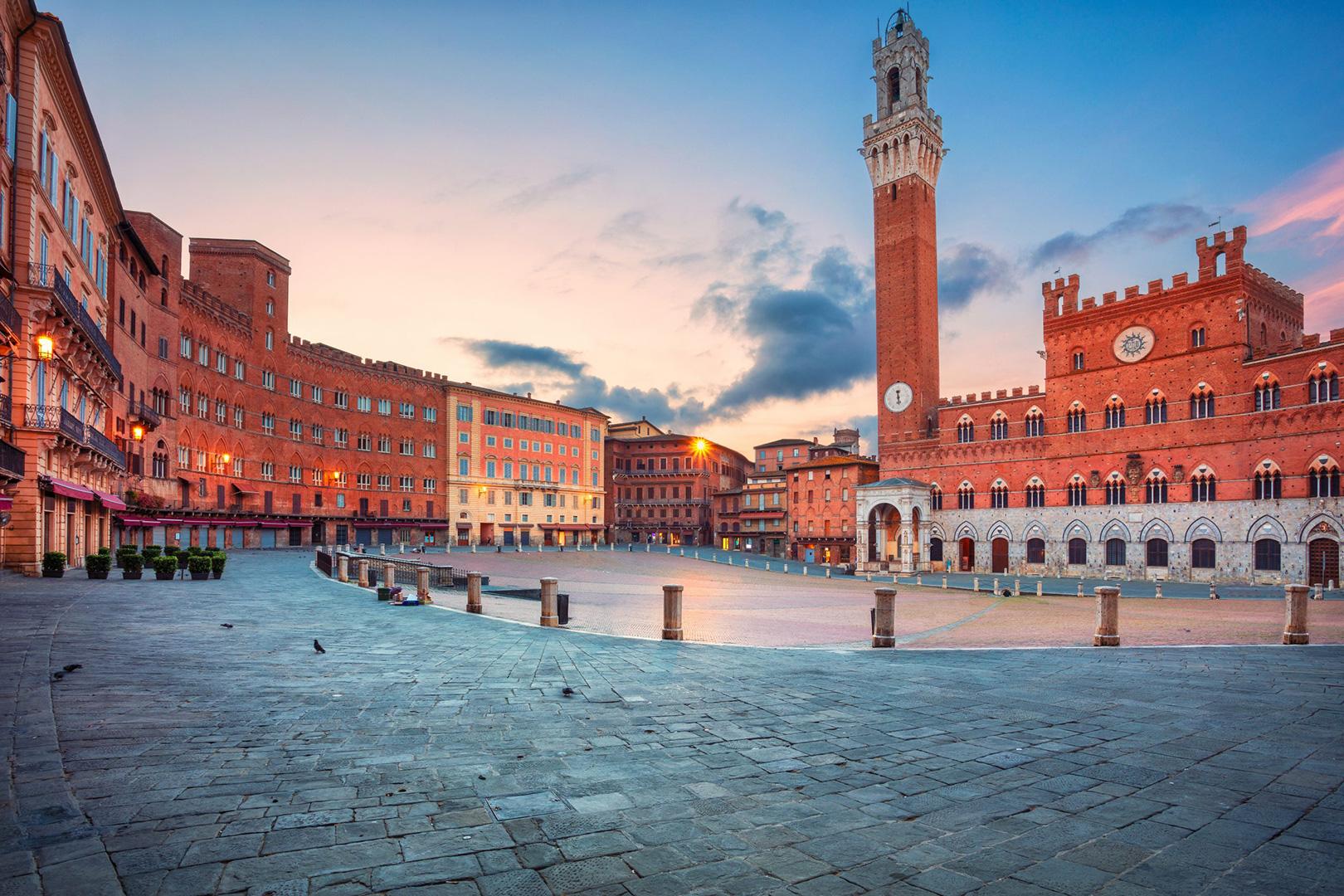
View the shell-shaped square.
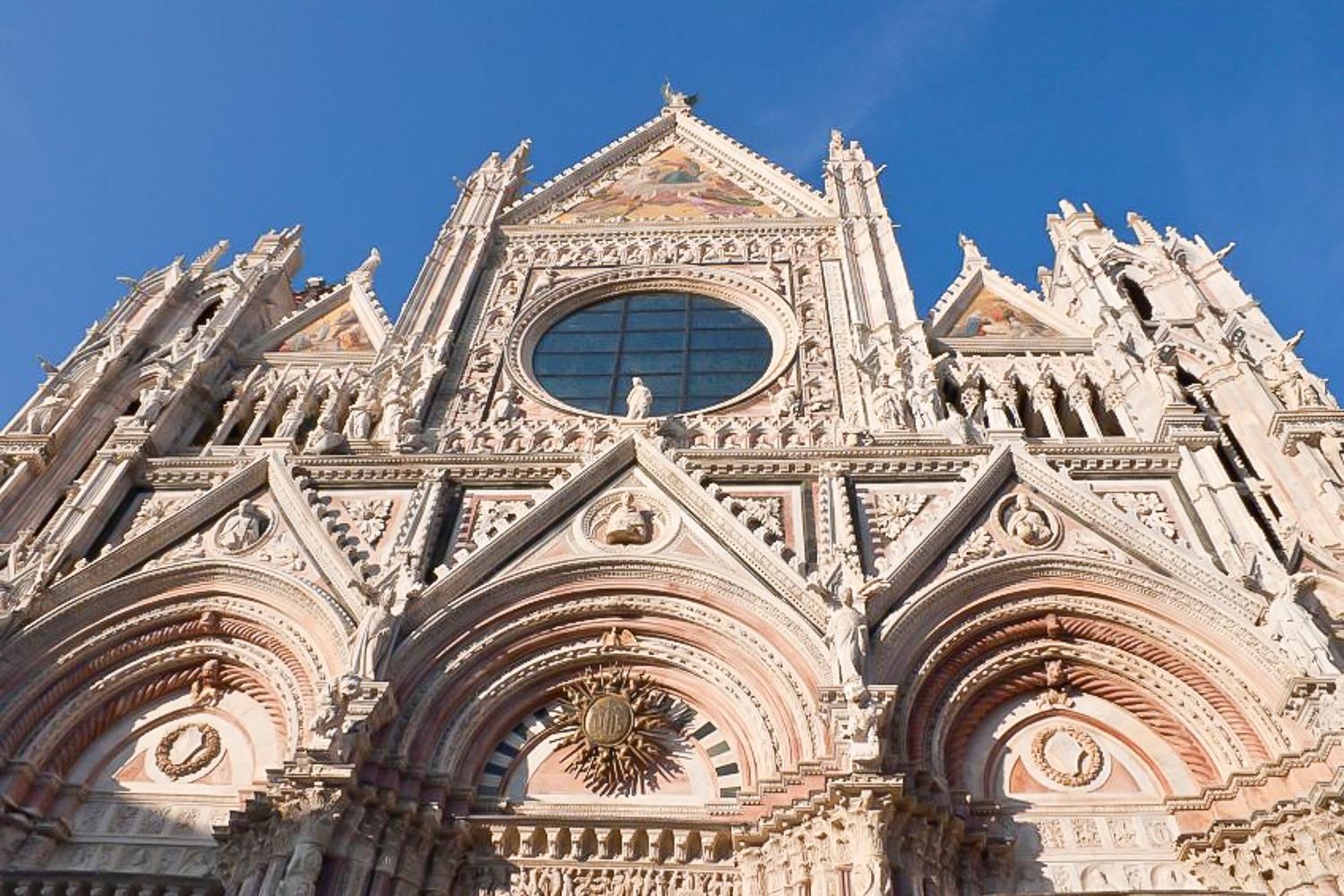
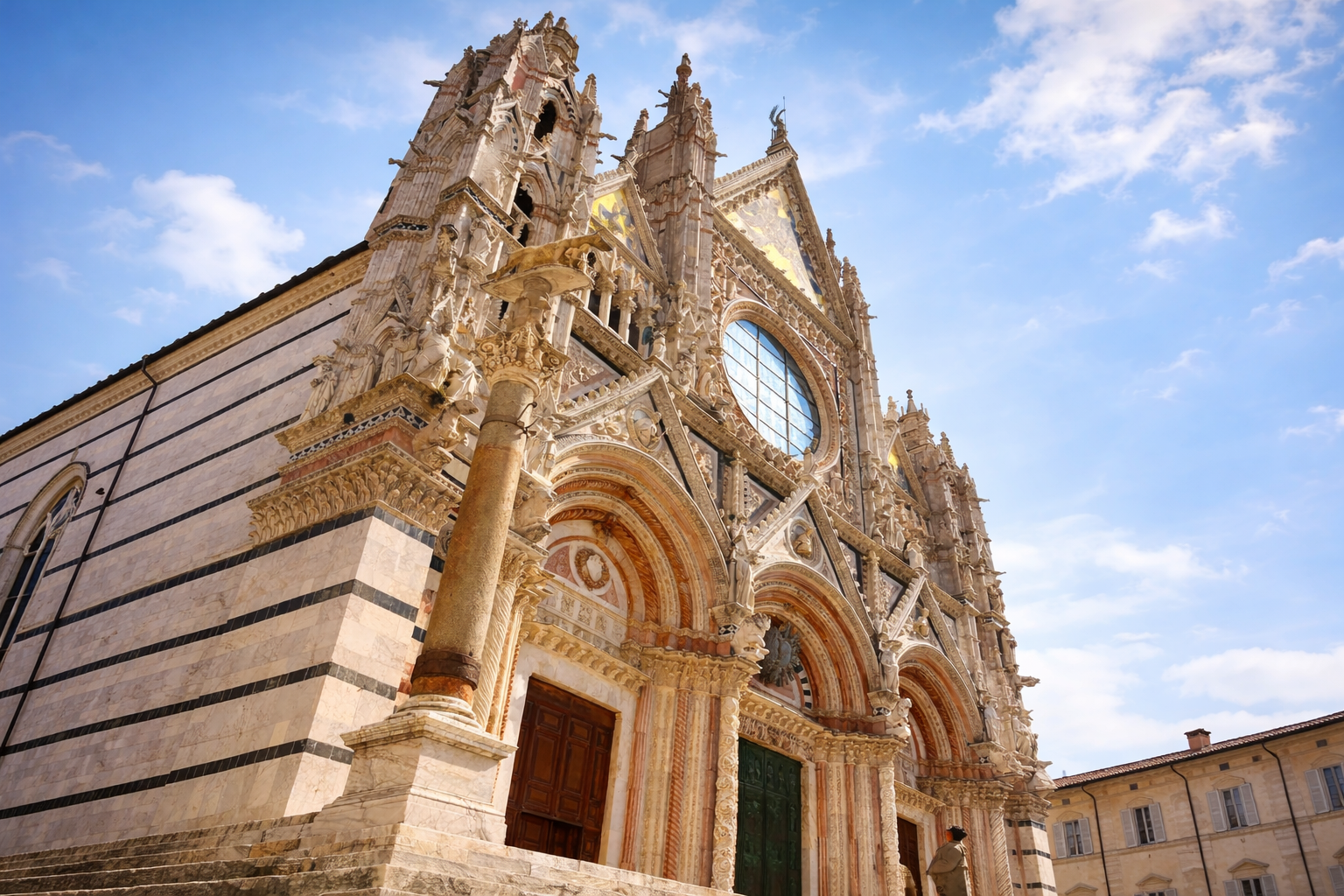
Explore the ornate marble facade.
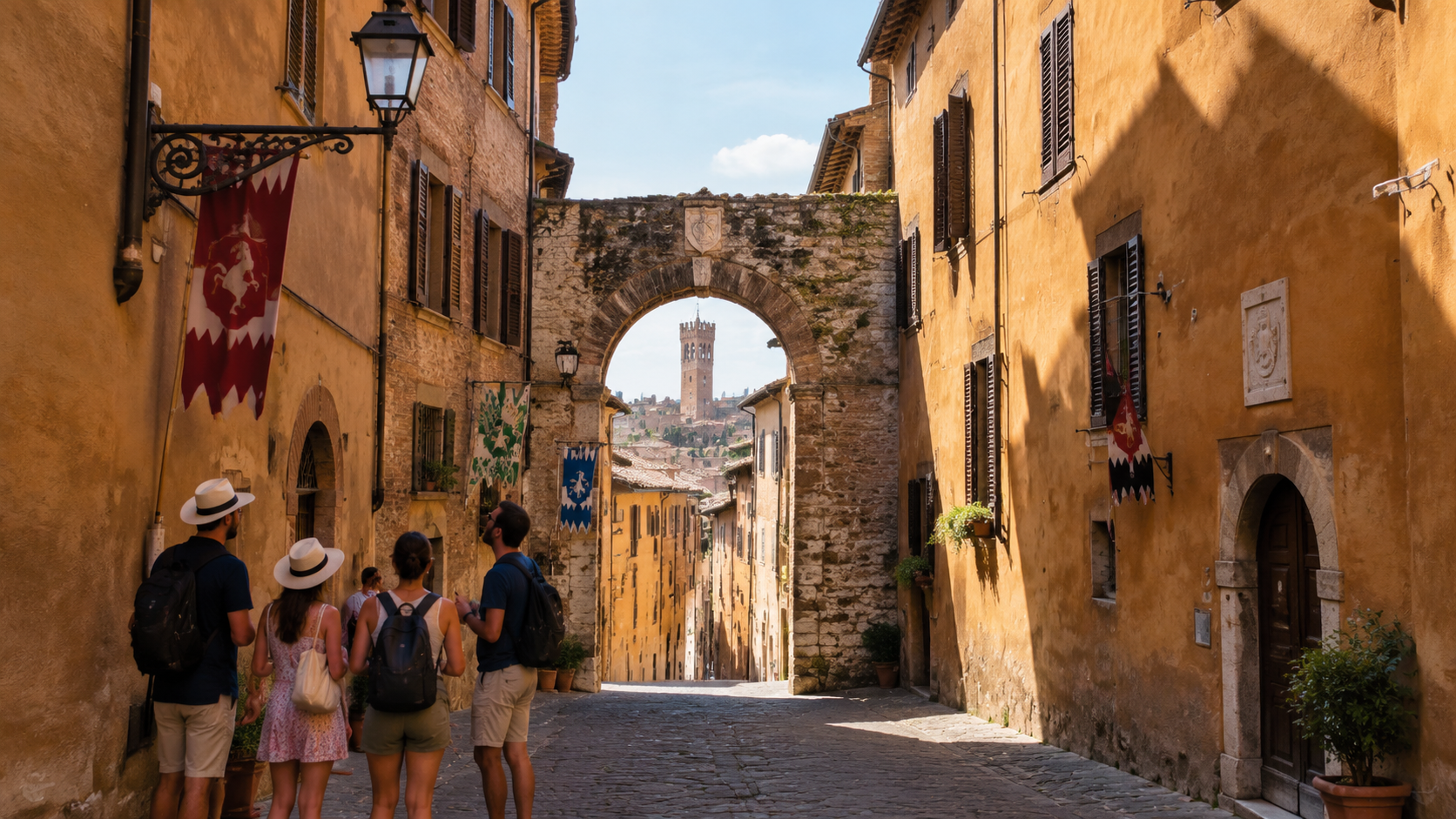
Walk the historic medieval artery.
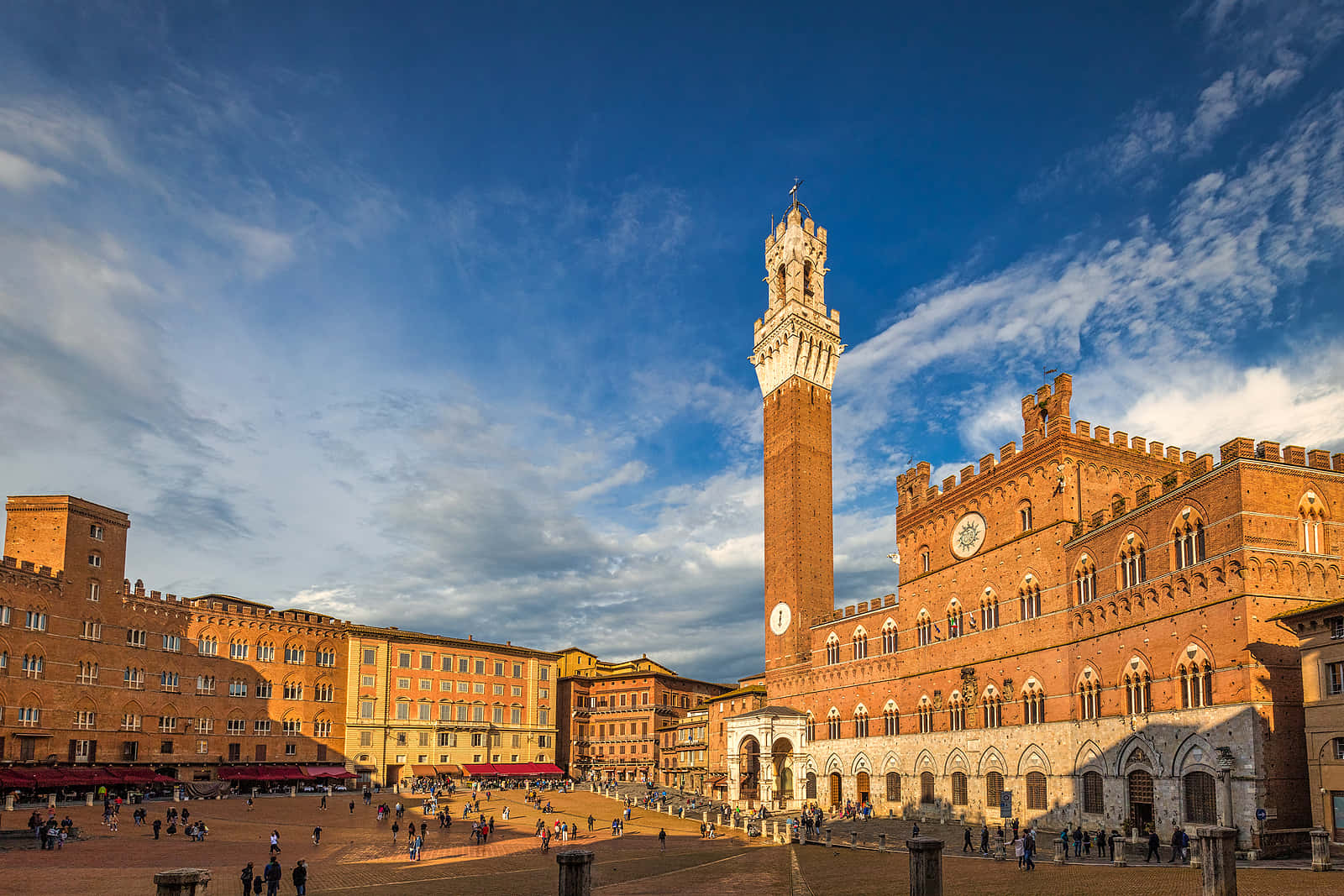
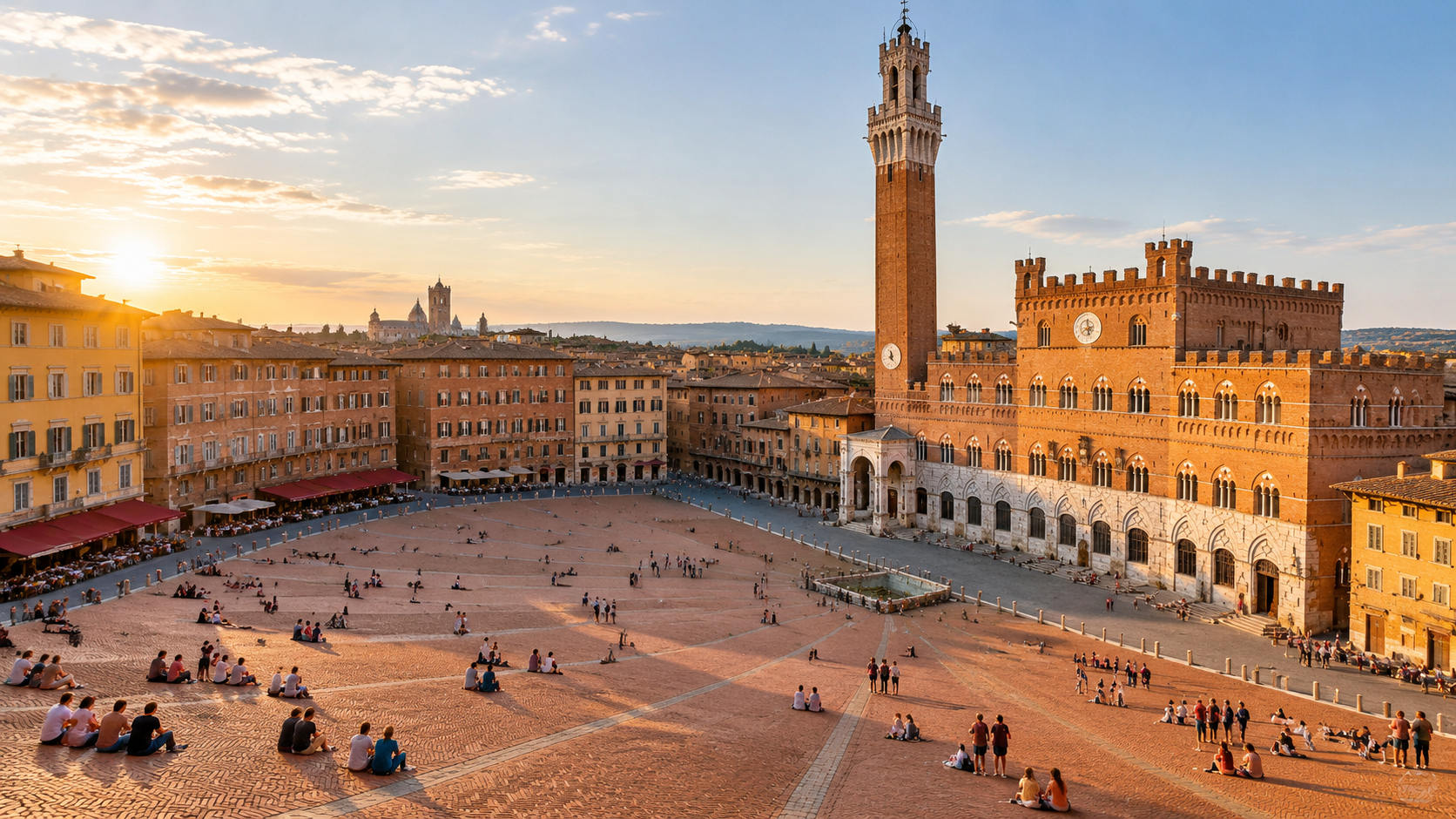
This shell-shaped square has served as the city heart since the 13th century and hosts the Palio horse race. Its unique nine-segment brick paving honors the Council of Nine.
Constructed between 1338 and 1348, this tower reaches 88 meters in height. It remains one of the tallest secular towers in medieval Italy.
This masterwork was originally sculpted by Jacopo della Quercia in the early 15th century. It features intricate biblical scenes carved into white marble.
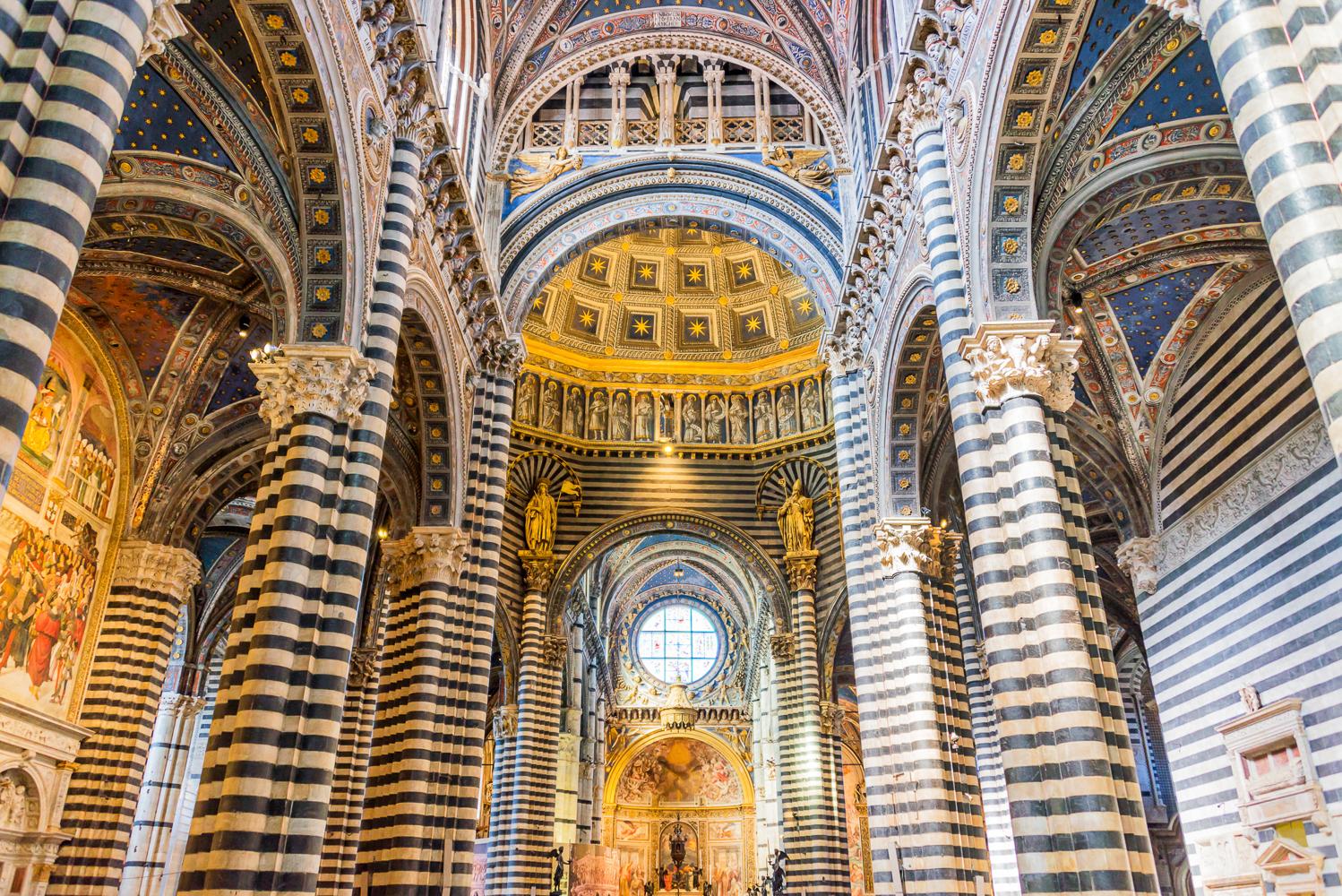
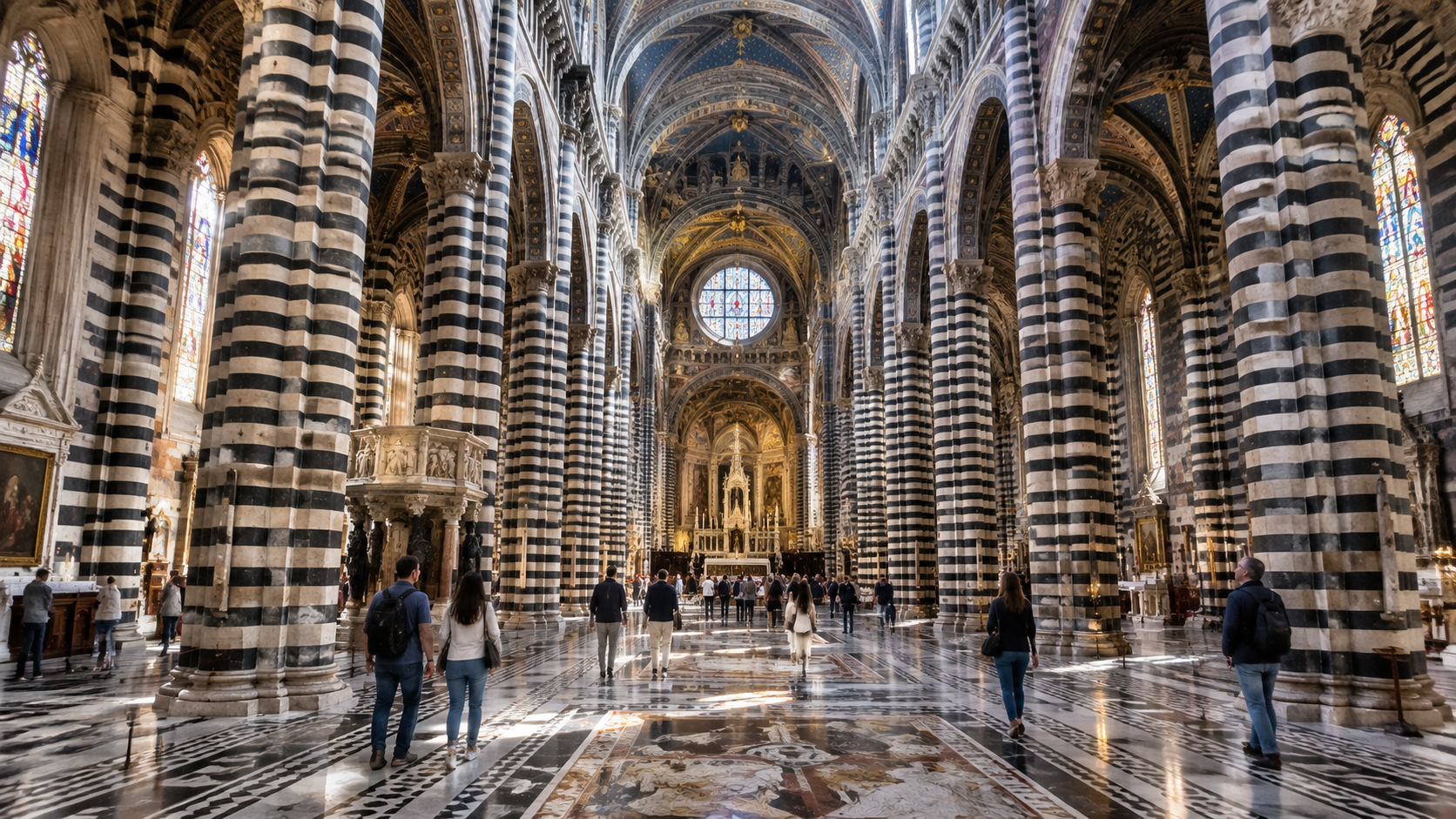
This cathedral is a masterpiece of Italian Romanesque-Gothic architecture featuring striped marble. The floor inside contains 56 engraved inlaid marble panels.
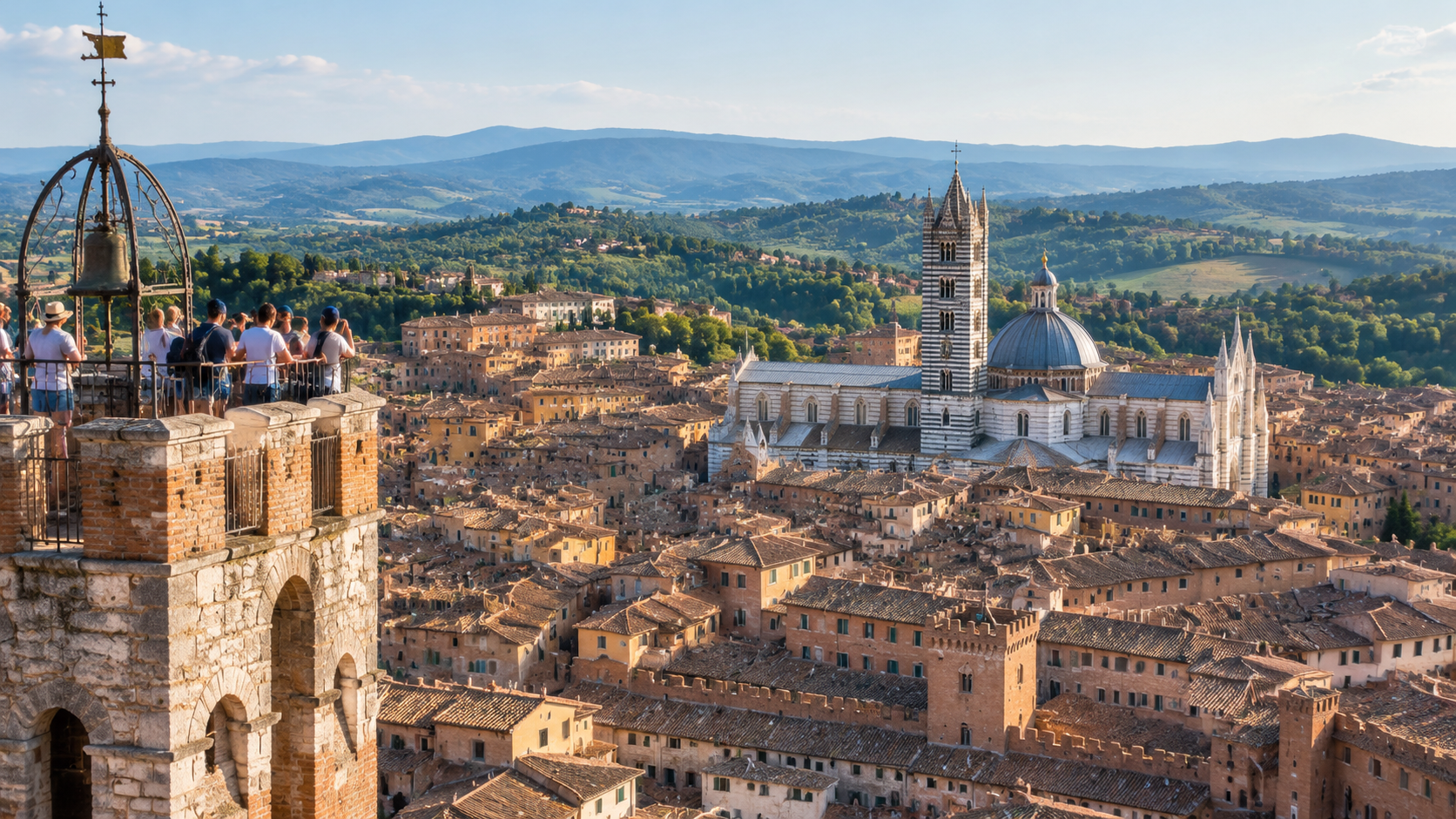
This massive brick structure dates back to the 13th century and overlooks the city valley. It houses the head of Saint Catherine of Siena in a dedicated chapel.
You arrive at Piazza del Campo shortly after eight in the morning, when the shell-shaped brick pavement is still in shadow and the café tables along the perimeter are just being set.
From the base of the Torre del Mangia, you follow Via di Città uphill, the street narrowing as it climbs between three-story palazzi whose ground-floor archways once sheltered wool merchants and money changers. At the Croce del Travaglio intersection, four streets converge beneath a canopy of iron streetlamps, and you turn left toward the Duomo.
The cathedral's striped marble façade appears in sections as you approach, framed by the buildings that press close on either side. You pause at the top of the Piazza del Duomo, where the steps descend toward the Baptistery, then circle behind the choir to reach Via di Diacceto, a vicolo so narrow two people cannot pass side by side. Here the plaster walls are unadorned, and the street drops steeply between buttresses that shore up the cathedral's eastern flank. You emerge onto Piazza San Giovanni, then follow Via dei Fusari west through the Oca contrada, where a ceramic fountain shaped like a goose marks the district boundary. The route ends at the Basilica di San Domenico, its unfinished brick nave towering above the valley that separates the western ridge from the centro storico.
All the details about your upcoming adventure in one place
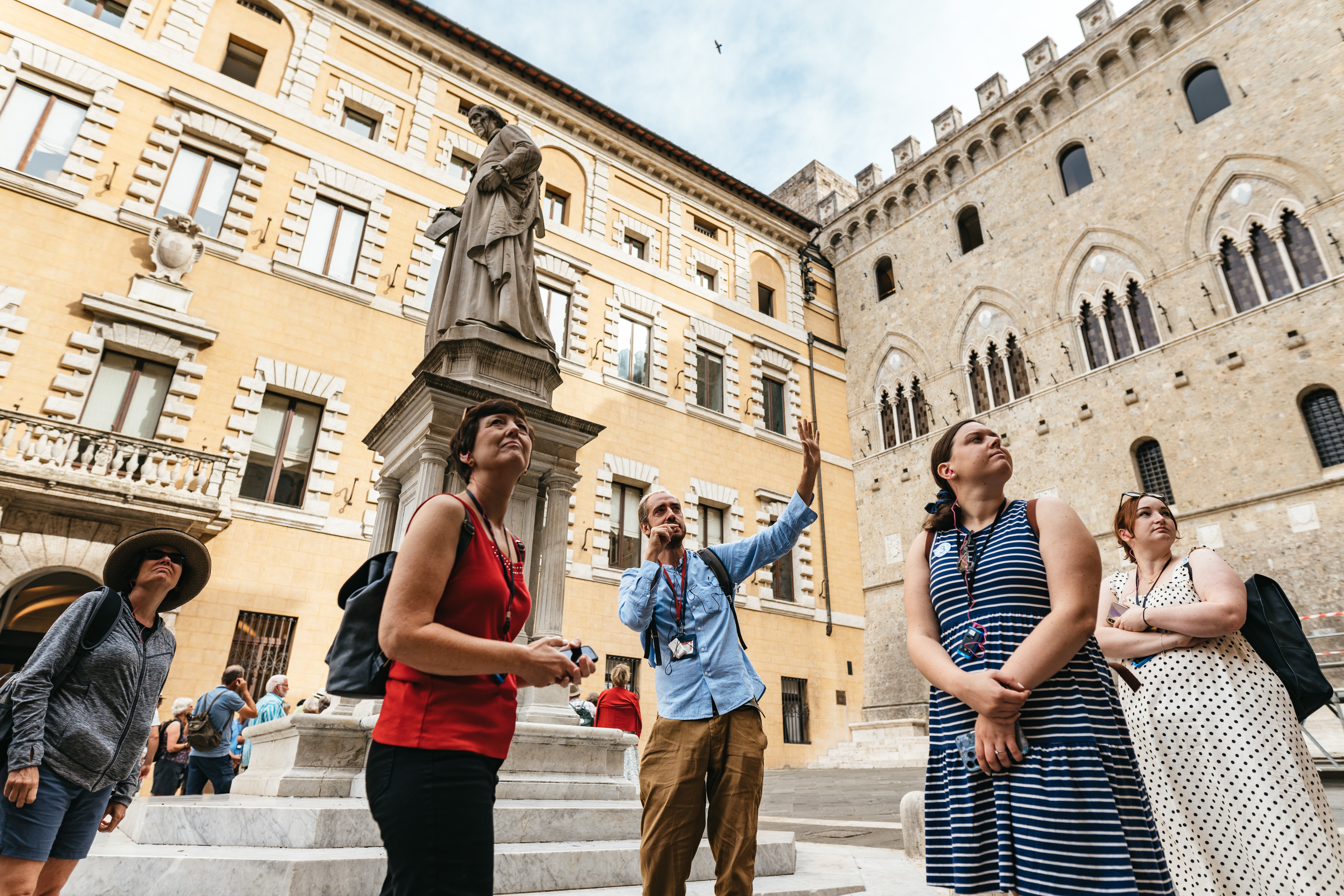
This siena walking tour explores the UNESCO-listed historic center through narrow medieval lanes and Renaissance piazzas. Guided siena walking tour tours cover the shell-shaped Piazza del Campo, Gothic palaces, and contrade neighborhoods that define the city's identity. Expert guides explain Sienese art, the Palio tradition, and civic architecture that has remained largely unchanged since the 14th century.
Siena's historic centre occupies three ridges that converge at Piazza del Campo, a shell-shaped public square paved in 1349 with nine radial sections representing the city's medieval ruling council.
The entire centro storico — 170 hectares of Gothic palazzi, contrade chapels, and brick-paved vicoli — was inscribed as a UNESCO World Heritage Site in 1995, recognized as one of Europe's best-preserved medieval urban landscapes. Unlike Florence, which rebuilt much of its core during the Renaissance, Siena retained its thirteenth and fourteenth-century street plan, a labyrinth of steep alleys that follow the natural contours of the tuff ridges on which the city stands.
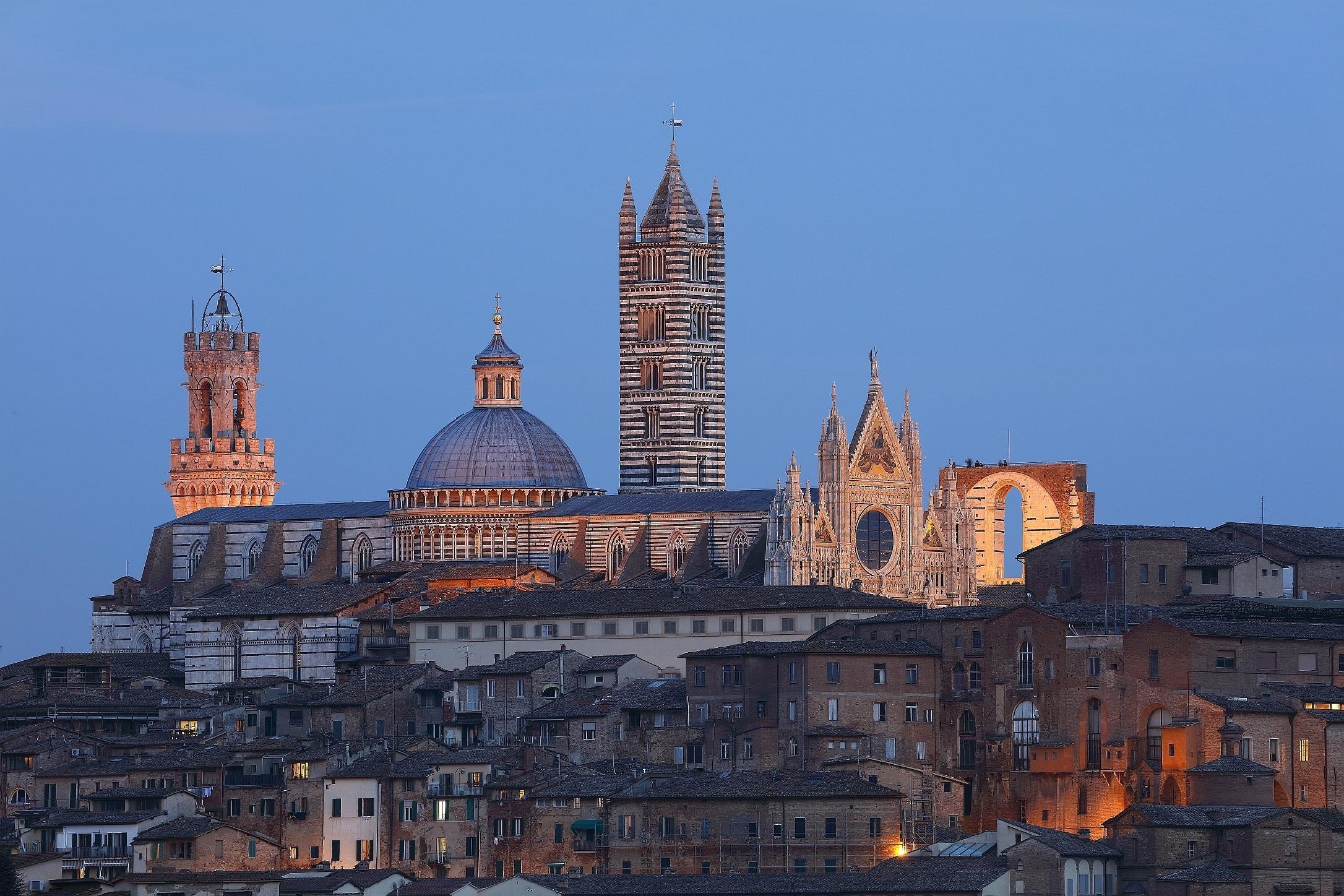
A Siena walking tour reveals the contrade system that still governs civic life: seventeen neighborhood districts, each with its own heraldic banner, fountain, and museum. The city's urban fabric is organized around these districts rather than a central grid, which means navigating Siena requires either a detailed map or a guide familiar with the vicoli that cut between major streets. The Duomo — built in alternating bands of white and green-black marble between 1215 and 1263 — anchors the southern ridge, while the Basilica di San Domenico commands the western hill. Between them stretches the Via di Città, the principal commercial artery, lined with thirteenth-century townhouses whose ground floors now house botteghe and enoteche.
Architecturally, Siena is defined by its use of local materials: travertine from the Montagnola hills, terracotta roof tiles fired in kilns south of the city, and the distinctive burnt-sienna plaster that gives the city its name. The Palazzo Pubblico, completed in 1342, anchors the lower curve of the Campo with its 102-meter Torre del Mangia, which held the civic bell that regulated market hours and curfews. Inside the palazzo, Ambrogio Lorenzetti's 1338 frescoes Allegory of Good and Bad Government remain the most complete surviving cycle of secular medieval painting in Europe.
Today, self-guided routes through Siena typically begin at Piazza del Campo, ascend the Via di Città past the Loggia della Mercanzia, and continue through the cathedral complex before descending through the San Domenico contrada. Free walking maps are available at the tourist office on the Campo, though many visitors now download georeferenced PDFs that overlay the contrade boundaries and mark the seventeen neighborhood fountains. Private guides licensed by the Provincia di Siena offer thematic routes focused on the Palio horse race, medieval banking families, or the Gothic architecture that defines the skyline.

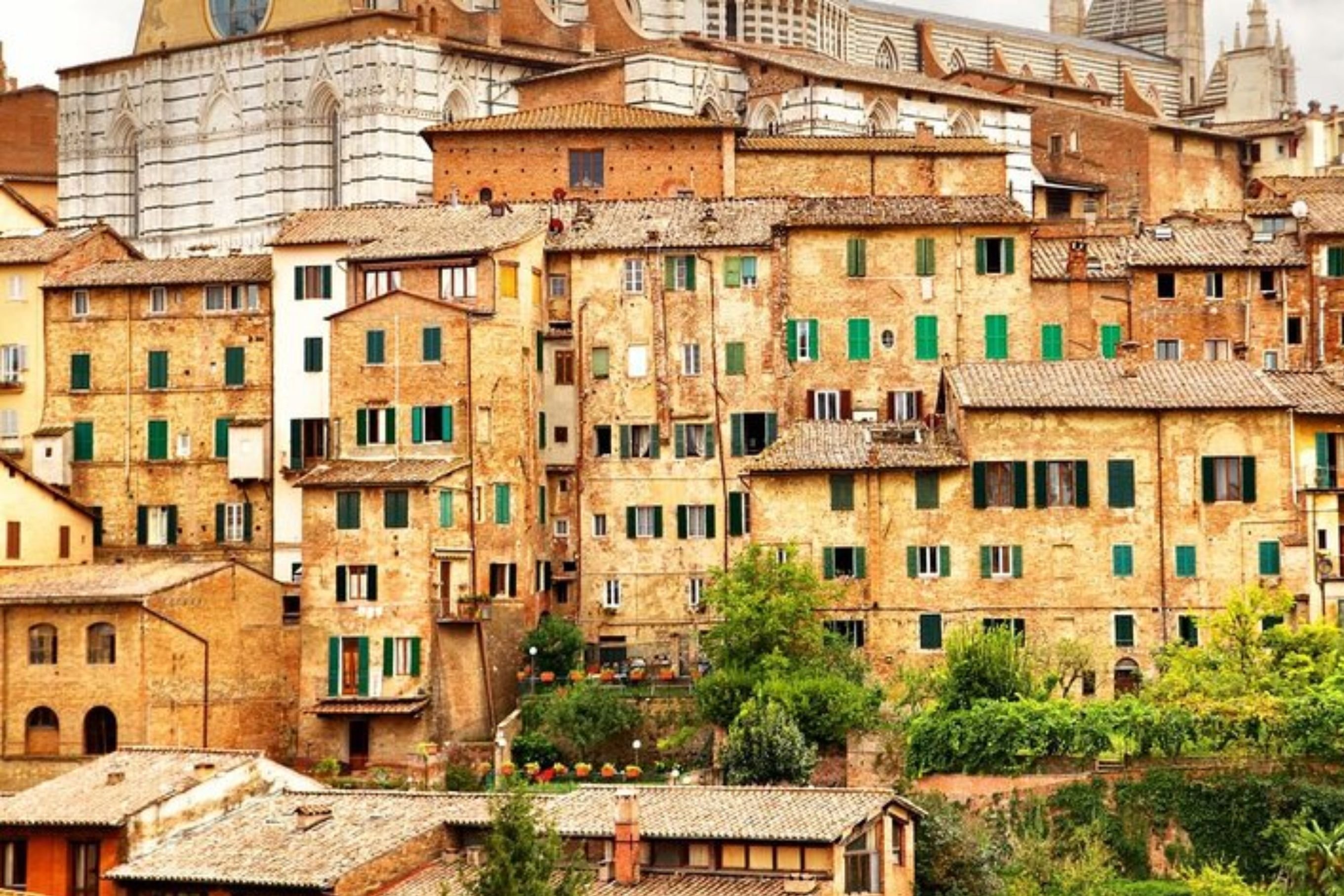
Siena retained its thirteenth and fourteenth-century street plan, a labyrinth of steep alleys that follow the natural contours of the tuff ridges.
Casual attire is appropriate for a siena walking tour. Visitors entering religious sites during the tour must ensure shoulders and knees are covered.
No specific security checkpoints exist for a siena walking tour. Keep personal belongings secure in crowded squares to prevent petty theft.
Photography is permitted in all public areas during your siena walking tour. Respect local residents by avoiding intrusive photos of private homes.
A siena walking tour is suitable for children, though strollers can be difficult to maneuver on narrow streets. Bring carriers for younger children to navigate stone steps.
The city center features steep inclines and uneven cobblestones typical of a medieval siena walking tour. Mobility-impaired visitors should plan routes carefully to avoid the most challenging hills.
Carry water bottles to refill at public fountains during a siena walking tour. Eating while walking is discouraged in historical zones.
Opening Hours
00:00–23:59
Address
Piazza del Campo, 53100 Siena, Italy
Public Access
Fully pedestrianized area
Best Arrival
08:00–10:00
Navigation
Follow historic center routes
Public transport · 1.5h · 5-10 EUR
Buses arrive at Piazza Gramsci or Viale Tozzi. Frequent connections exist to Florence and nearby towns.
Walk · 20m · Free
From the train station, use the escalator system to reach the city center.
As public space entry is 0 EUR, no formal cancellation is required for a siena walking tour. Private guide bookings generally offer full refunds if cancelled 24 hours in advance.
Recommended time
3-4 hours
A comprehensive siena walking tour typically requires three to four hours to properly explore the medieval alleyways and historic limestone architecture. Guests often find that siena walking tour tours provide sufficient depth for major landmarks, though adding time is recommended if you wish to enter the Duomo. Planning your siena walking tour tour effectively relies on hitting the streets early to avoid the peak volume of day-trippers. Because siena walking tour tickets are not required for public squares, you can enjoy a fluid experience by prioritizing a morning start.
Crowd levels through the day
Weather · crowds · average price — dots go green to amber to red as each metric rises.
Mild temperatures and blooming flowers make this ideal for walking tours.
Expect high heat; prioritize morning hours to avoid midday sun.
Cooler air and harvest events create a perfect atmosphere for exploring.
Crowds are thin, though temperatures require warm, layered clothing.
Use the Risalita di Fontebranda escalators to avoid steep climbs from the train station.
Fill bottles at the historic fountains found throughout the city streets.
Follow the recommended 08:00–10:00 arrival window to experience quieter alleys.
Prioritize flat, rubber-soled footwear to handle the ancient cobblestone streets.
Verify local festival schedules, as dates like the Palio impact accessibility in the square.
Siena's urban fabric crystallized between 1150 and 1350, when the Republic of Siena controlled one of Europe's most powerful banking networks. The Campo, Siena's shell-shaped central piazza, was paved in 1349 with nine sections radiating from the Palazzo Pubblico, each division representing one of the Nine who governed the commune. The Torre del Mangio rose to 102 meters in 1348, deliberately built one meter taller than Florence's rival tower. Plague struck that same year, killing two-thirds of the population and freezing construction across the city. The cathedral expansion, begun in 1339 to create the largest church in Christendom, was abandoned mid-construction; its unfinished nave walls still stand as a monument to interrupted ambition. The contrade system—seventeen neighborhood districts that define Sienese identity—evolved from military companies in the 1200s into civic-religious societies by the 1400s. Each contrada maintains its own church, fountain, museum, and ceremonial life, a structure that has preserved medieval social geography for seven centuries. The Palio horse race, formalized in its current twice-yearly format in 1656, remains the engine of contrada loyalty and the reason Siena's medieval streets have resisted automotive restructuring. When you walk these lanes today, you trace boundaries defended not by walls but by baptismal affiliation. Siena's preservation is deliberate, not accidental. In 1309, the commune passed Europe's first urban aesthetic law, regulating building heights and mandating terracotta brick for all facades. This ordinance has been enforced for 717 years. The city submitted to Florence in 1555 after a catastrophic siege, entering a political eclipse that paradoxically saved it from Renaissance and Baroque remodeling. While Florence rebuilt, Siena stayed Gothic. The result is a walkable archive, where contrade flags still hang from iron brackets forged in the 1300s and siena walking tour routes follow the same commercial arteries that carried Sienese bankers to dominance and collapse.
The Republic of Siena establishes Europe's oldest bank, Monte dei Paschi, and begins construction of the Duomo.
The Council of Nine governs Siena during its artistic and economic peak, commissioning the Palazzo Pubblico and paving the Campo.
The Black Death kills 65% of Siena's population, halting the cathedral expansion and ending plans for territorial dominance.
Florence conquers Siena after a fifteen-month siege, ending the Republic and freezing urban development for centuries.
The Palio assumes its modern form with twice-yearly races in the Campo, codifying the seventeen contrade into permanent rivalry.
UNESCO designates Siena's historic center a World Heritage Site, recognizing its preserved medieval urban planning and contrada culture.
Stand in the middle of the shell-shaped square to capture the sweeping lines of the medieval brick buildings and the Torre del Mangia. This siena walking tour location offers a wide perspective of the historic drainage gullies.
Position yourself across the square to frame the intricate black-and-white marble carvings and the ornate gothic statues. This landmark is a highlight for those on a siena walking tour tours.
Climb the panoramic terrace at the museum for a high-angle shot of the city skyline and the surrounding Tuscan hills. This is a popular spot for professional siena walking tour tour photography.
Frame the sculptural white marble fountain against the backdrop of the surrounding palaces. This architectural feature provides a classic composition for any siena walking tour tickets holder.
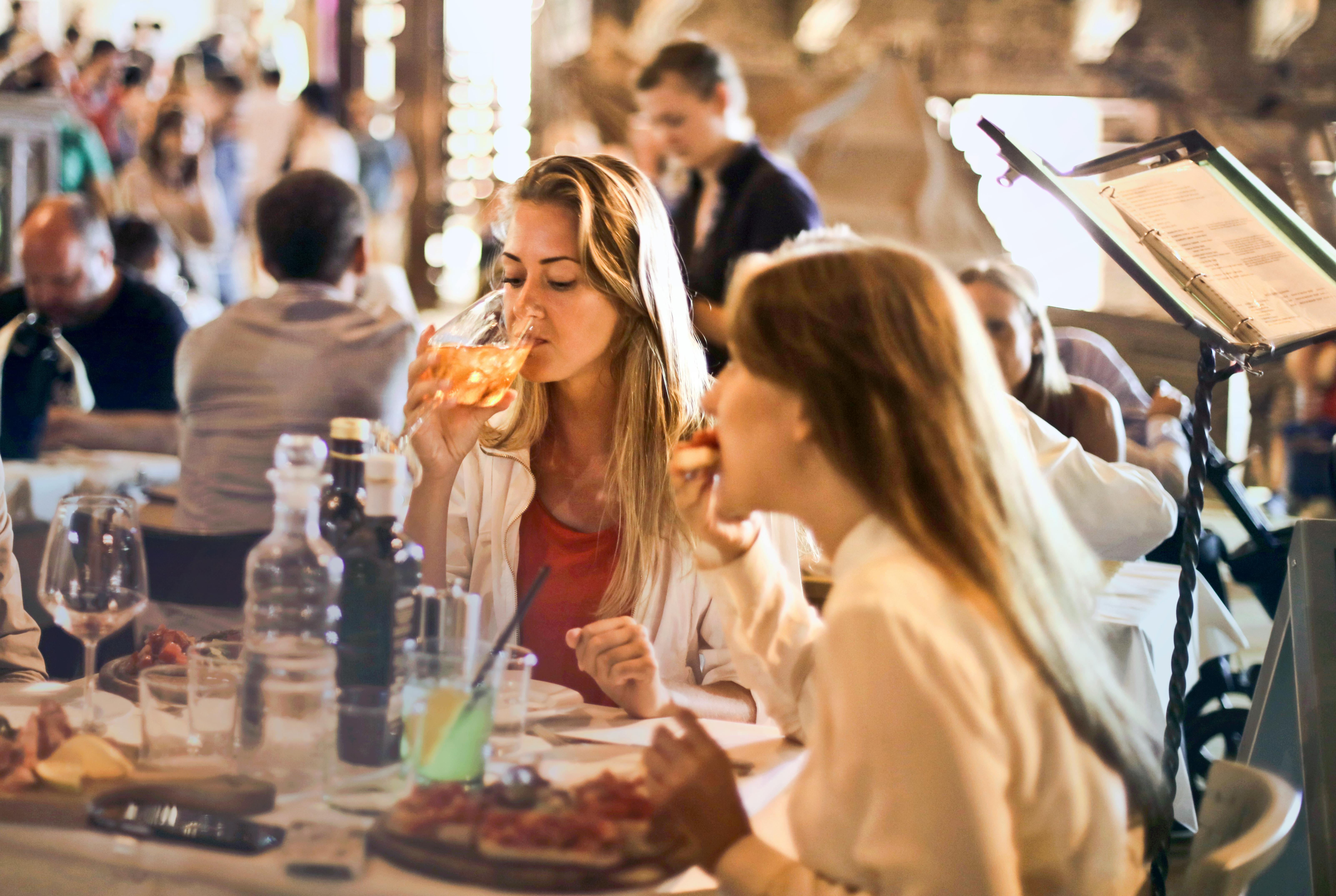
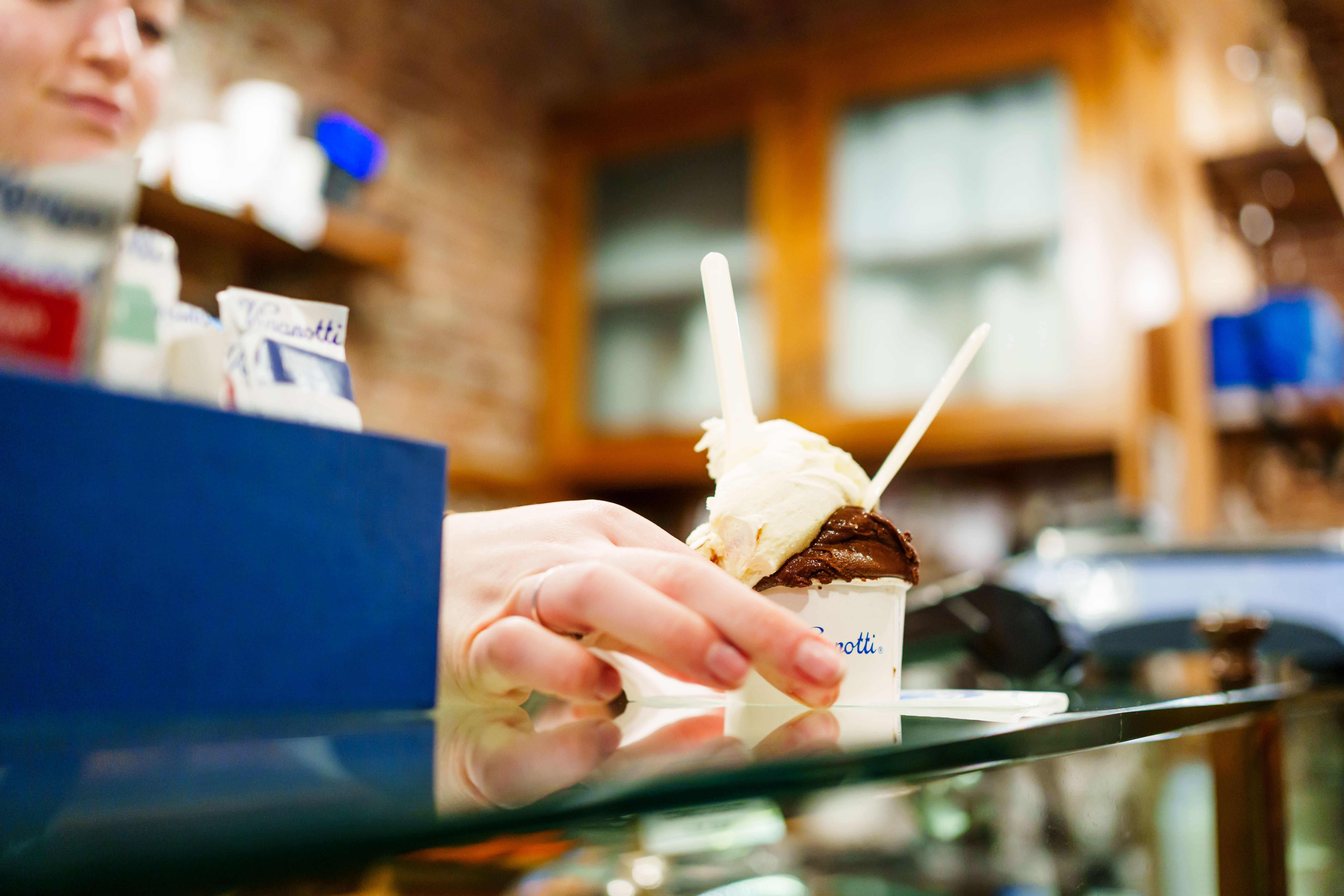
Exploring the historic center during a siena walking tour offers numerous opportunities to sample authentic Tuscan flavors. While the central square is primarily for pedestrian traffic, excellent trattorias and cafes are situated just steps away from this Siena landmark.
Located steps from the square, this venue offers refined pasta dishes and local meats. It is a popular choice for those finishing their siena walking tour tours.
Real experiences from real travelers
We joined a siena walking tour on a crisp September morning and covered the essential landmarks in under three hours. Our guide explained the Palio traditions as we crossed Piazza del Campo, then led us through the contrade neighborhoods where each district's symbols are painted above doorways. The cathedral's floor panels were uncovered during our visit, which added unexpected detail.
This guided walk through Siena's historic center balanced architecture with local stories. We paused in the shade of the Palazzo Pubblico while learning about the medieval republic, then wound through narrow lanes to reach the Duomo. The timing worked well; we finished before the midday heat became uncomfortable.
A siena walking tour was the right choice for our first afternoon in the city. The route connected Piazza del Campo, the cathedral complex, and several lesser-known contrade squares. Our guide pointed out details we would have missed on our own, like the marble she-wolf fountains and the faded fresco fragments in side streets.
The tour itself was solid, covering the Duomo, the Torre del Mangia viewpoint discussion, and the banking district where the Monte dei Paschi began. August crowds made it hard to hear at times in Piazza del Campo, but the guide adapted by moving us to quieter spots. Would recommend going earlier in the season.
Our walk began at the Basilica di San Domenico and descended through residential contrade before reaching the main square. The guide's knowledge of Sienese Gothic architecture and the rival contrade system made the three-hour loop engaging. We appreciated the focus on lesser-visited corners beyond the obvious landmarks.
This siena walking tour tickets option included skip-the-line entry to the Duomo complex, which saved us at least thirty minutes. The guide led us through the baptistery, the cathedral floor, and the Piccolomini Library without rushing. The route also took in Via di Città's medieval palaces and a quiet courtyard near Porta Romana.
We explored Siena's historic core on foot with a guide who tailored the commentary to our interests in Renaissance art and civic history. The route included the Pinacoteca galleries, the Campo, and the cathedral. Spring light was ideal for photography, and the smaller group size allowed for questions throughout.
A morning siena walking tour gave us a solid foundation before exploring on our own in the afternoon. We covered the major contrade, learned about the Palio horse race preparations, and climbed partway up Torre del Mangia for the view. The guide's pacing was considerate, with rest stops in shaded piazzas.
Visiting Siena in January meant fewer tourists and softer light across the terracotta rooftops. Our guided walk took us through the contrade neighborhoods, the Campo, and the Duomo without the usual crowds. The guide shared stories about the medieval guilds and the city's banking legacy as we moved through quiet lanes.
This siena walking tour tour connected the dots between the city's layout and its history as an independent republic. We walked from the Fontebranda spring to the cathedral, pausing at contrade fountains and medieval tower houses along the way. The guide's commentary on the rival neighborhoods and their Palio traditions added depth to what we saw.
Everything you need to know for your journey
Public areas are accessible 00:00–23:59 daily, allowing flexibility for your siena walking tour. Always check specific indoor landmark hours separately.
Entry to public squares and streets is 0 EUR, meaning no tickets are required for a general siena walking tour. Private guided tours may involve separate service fees.
The historic medieval center features uneven cobblestones and steep inclines, making some areas of a siena walking tour challenging for standard wheelchairs.
The best arrival window is 08:00–10:00 to avoid crowds and heat during your siena walking tour. This period offers the most pleasant temperatures for exploration.
Photography is permitted in all open-air locations during your siena walking tour. Respect privacy when capturing images of residential areas.
While general public access is free, items like large luggage or drones are not suitable for a siena walking tour. Keep items minimal for easier mobility.
Yes, many operators offer group siena walking tour tours for larger parties. Booking in advance ensures availability for your preferred date.
Drinking water is encouraged, but eating while walking through the historic district is discouraged during a siena walking tour. Use local cafes for meals.
You can easily combine a siena walking tour with visits to the Duomo di Siena or Torre del Mangia. These landmarks are within short walking distance of the central square.
A tall bell tower offering views of the city.
A decorative Renaissance fountain in the main square.
A brick church containing historical relics.
Stay within walking distance of all sites.
Quiet district near the main landmarks.
Good access to transport connections.
Join thousands of happy travelers who have discovered this incredible experience
Book Your Experience Now